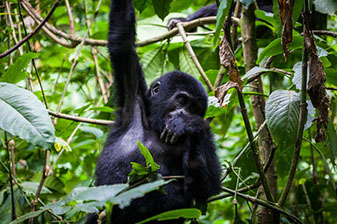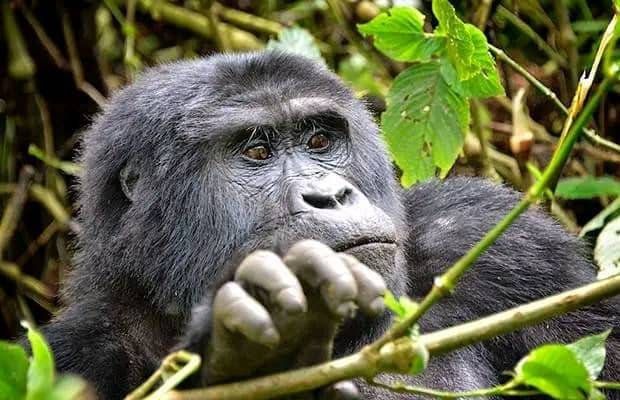
Dawn arrives slowly over the misty hills of southwestern Uganda. As the first light breaks through the ancient forest canopy of Bwindi Impenetrable National Park, a thick layer of mist begins to lift, revealing one of Africa’s most extraordinary wilderness landscapes.
You tighten your boots, adjust your backpack, and step onto a narrow forest trail covered with rich volcanic soil. Around you stretches an endless sea of green, towering trees, tangled vines, giant ferns, and the sounds of a forest waking up. Birds call from hidden branches, leaves rustle beneath your feet, and somewhere deep inside the jungle, a family of mountain gorillas is waiting.
After hours of trekking through the dense vegetation, your ranger suddenly stops.
The search is over.
With a careful movement of his machete, he opens a path through the thick foliage. Just a few metres away, sitting quietly in a small clearing, is one of the world’s most remarkable creatures — a mountain gorilla silverback.
Massive yet calm, powerful yet gentle, he sits beneath the forest canopy as if he has always belonged there. His size is unforgettable, but it is his eyes that leave the deepest impression. There is an intelligence and curiosity in his gaze that feels almost familiar, a brief connection between two species separated by millions of years of evolution.
Nearby, a mother carefully grooms her infant, while a playful young gorilla swings through vines and rolls across the forest floor. The group carries on with its daily life, seemingly unbothered by your presence.
For a moment, everything else disappears.
A gorilla trek in Bwindi is unlike any ordinary wildlife experience. This is not a safari where you watch animals from a distance. It is an intimate journey into the heart of one of the world’s oldest forests and a rare opportunity to spend time with one of our closest living relatives.
The trek may challenge you, the steep trails, thick vegetation, and unpredictable mountain weather are all part of the adventure. But the reward is an experience that stays with you long after you leave the forest.
Meeting a mountain gorilla in the wild is not just about seeing an animal. It is about standing in the presence of a species that reminds us of where we come from, and why protecting these forests matters.
1. What is Gorilla Trekking?
Gorilla trekking is a highly controlled, active wildlife adventure that involves hiking through dense, high-altitude rainforests to locate a specific habituated mountain gorilla family. Once the group is found, visitors spend exactly one hour observing them in their natural habitat.
Why Bwindi is Globally Famous
Unlike open savannahs where safari vehicles do the work, Bwindi Impenetrable National Park requires you to venture deep into the forest on foot. Bwindi is world-famous because it holds roughly half of the planet’s remaining wild mountain gorillas (Gorilla beringei beringei). The remaining population lives across the nearby Virunga Massif, which spans Rwanda and the Democratic Republic of Congo.
The Conservation Success Story
Decades ago, mountain gorillas faced imminent extinction due to rampant poaching, civil conflict, and habitat destruction. They cannot survive in captivity; every single mountain gorilla you see must be visited in the wild.
Through intensive, community-centered ecotourism managed by the Uganda Wildlife Authority (UWA), their status was upgraded from Critically Endangered to Endangered. Tourism funds the heavily armed park rangers who eliminate wire snares and protect the forest borders from illegal logging.
Supporting Surrounding Communities
By law, a direct percentage of all permit revenue is shared directly with the communities living along the park boundaries. This funding builds schools, funds health clinics, and improves local infrastructure. Because local residents are employed as guides, trackers, rangers, and lodge staff, they now view the forest as a vital economic asset rather than a competitor for farm land.
2. About Bwindi Impenetrable National Park
Bwindi is an ancient, legendary forest. As a designated UNESCO World Heritage Site, this 321-square-kilometer park has stood for over 25,000 years, surviving the last Ice Age when most of Africa’s forests dried up.
The Extreme Terrain and Atmosphere
The name “Bwindi” translates from the local Runyakitara language as “a place of darkness,” a direct nod to its impossibly thick canopy. The forest is characterized by steep, muddy ridges, slippery valleys, and a dense tangle of bamboo, giant tree ferns, and wrapping lianas.
Exceptional Biodiversity
Bwindi is one of the richest ecological ecosystems on earth. Beyond mountain gorillas, it provides a sanctuary for:
- 120 Mammal Species: Including forest elephants, side-striped jackals, and several small antelope species.
- 10 Primate Species: Including wild chimpanzees, L’Hoest’s monkeys, black-and-white colobus monkeys, and nocturnal bushbabies.
- 350 Bird Species: Featuring 23 Albertine Rift endemics, such as the African green broadbill and the Shelley’s crimsonwing.
- 220 Butterfly Species: Making it a global hotspot for entomologists.
3. Planning Your Gorilla Trek
Planning a successful trek requires navigating permit systems, mountain weather patterns, and strict park regulations.
2026 Verified Permit Costs & Booking Policies
The Uganda Wildlife Authority (UWA) regulates all access to ensure gorilla safety.
- Foreign Non-Residents (FNR): $800 USD per trek during standard high-season months.
- Low-Season “Green” Discount: In 2026, UWA offers promotional permits at $600 USD for the rainy months of April, May, and November. These permits are date-specific and cannot be rescheduled.
- Foreign Residents (with work permits): $700 USD (High Season) / $500 USD (Low Season).
- East African Citizens (EAC): 300,000 UGX.
🚨 CRITICAL 2026 POLICY UPDATE: As of March 1, 2026, UWA has completely eliminated the 7-day “soft hold” option for tour operators. Full payment must be made instantly at the time of booking to secure a permit spot.
Group Sizes and Age Limits
To preserve gorilla health, a maximum of eight visitors is permitted to visit any single gorilla family per day. The absolute minimum age to participate in a trek is 15 years old.
Standard Trek vs. Gorilla Habituation Experience (GHEX)
When booking, you can choose between two distinct styles of encounters:
- Standard Gorilla Trek: You spend exactly one hour observing a fully habituated family that is completely accustomed to human presence.
- Gorilla Habituation Experience (GHEX): Restricted exclusively to the Rushaga sector, this allows a small group of up to four visitors to spend four hours with a wild gorilla family undergoing the 2-to-3-year process of becoming habituated. Guided by expert trackers and research scientists, you will watch them map behaviors and test vocalizations. The 2026 permit fee for GHEX is $1,800 USD for foreign non-residents.
4. The Four Gorilla Trekking Sectors
Bwindi is managed across four distinct sectors, each featuring its own entry gates, ranger headquarters, terrain profiles, and unique gorilla groups. You must book your accommodation in the same sector as your permit, as driving between sectors on the morning of a trek is impossible due to rough dirt roads.
Buhoma (North)
Buhoma is the historic birthplace of gorilla tourism in Uganda, where the very first commercial trek took place in 1993. It features the lowest altitude in the park, making the hikes gentler on average compared to the south. It hosts the highest concentration of high-end luxury lodges and is perfect for older travelers or families looking for a classic safari infrastructure.
Ruhija (East)
Sitting at an altitude of over 2,300 meters, Ruhija is a cool, mist-covered sector favored by serious hikers and birdwatchers. The trails run deep into ridges and require a reasonable level of cardiovascular fitness. It offers a remote, less-crowded feel with fantastic panoramic views of the Virunga volcanoes.
Rushaga (South)
Rushaga sits in the rolling hills of the southern edge of the park and boasts the highest number of habituated gorilla families. Because of this, it has the largest pool of daily permits available. It is also the exclusive home of the Gorilla Habituation Experience (GHEX). Accommodation here ranges from charming budget eco-camps to great mid-range options.
Nkuringo (South)
Nkuringo provides the most dramatic scenery in the park, directly overlooking the rugged rift valley and the jagged peaks of the Virunga chain. However, it is also home to the most physically challenging trails. The trek out of the forest involves a steep, continuous climb that requires excellent stamina. It is perfectly suited for active travelers and experienced trekkers.
5. What Happens on Trekking Day?
└────────────────────────────────────────────────────────┘
Morning Briefing and Allocation
Your day begins early at the sector headquarters. Rangers inspect your passports and confirmation permits. While you enjoy hot Ugandan coffee provided by the park staff, local community groups often perform traditional dances.
The Lead Warden will then split visitors into intimate groups of eight. If you prefer a shorter or more challenging hike, let your guide know now so they can match you with an appropriate gorilla family based on where trackers located them at dawn.
Meeting Your Forest Support Crew
You will be assigned a Lead Ranger-Guide, two armed Wildlife Rangers (to protect against wild forest elephants by firing warning shots if necessary), and professional trackers.
This is also where you meet the local porters. Hiring a porter is highly recommended, even if you are in peak physical shape. For a set fee of $20 USD, they carry your heavy daypack, pull you up steep muddy inclines, and ensure you keep your footing on slippery roots. Hiring a porter provides vital income to families living on the park borders.
Entering the Impenetrable Forest
Leaving the cultivated fields behind, you cross the park boundary line and plunge directly into the thick foliage. Trackers use machetes to clear a path through stinging nettles and tangled branches. You will listen to the rangers communicate via shortwave radio with the advance tracking team, who have been trailing the gorillas since 6:00 AM.
The Moment of Encounter
When you approach the gorillas, the lead ranger will call a halt. You will leave your walking sticks and backpacks with the porters and proceed with just your camera and rain gear.
The rangers make low, throaty grunting noises—a reassuring gorilla sign that means “we come in peace.” Step by step, you enter the clearing. The physical exhaustion of the hike instantly vanishes as you look directly into the eyes of a wild silverback gorilla. For sixty unforgettable minutes, you watch them live their life completely undisturbed by your presence.
6. How Difficult is Gorilla Trekking?
Gorilla trekking is a demanding physical activity that requires navigating rugged terrain. There are no paved trails or boardwalks inside Bwindi; you are hiking through wild, unmanaged wilderness.
Typical Trekking Durations
Treks can last anywhere from 45 minutes to 7 hours, depending entirely on the movement of the gorillas. Because they build a new nesting site every night, their location changes constantly. A family that was a short walk away yesterday might cross a steep mountain ridge today in search of fresh bamboo shoots.
Accommodating Older Travelers and Limited Mobility
Age or limited mobility should not prevent you from experience this adventure. For elderly travelers or those with physical disabilities, you can hire a “Sedan Chair” (locally called the Helicopter). A team of 8 to 12 local porters will carry you safely into the forest and directly to the gorillas. This service costs between $300 and $400 USD, with all funds going directly to the community carriers.
7. What You’ll Actually See
The complex social structure of a mountain gorilla family makes observing them feel remarkably like watching human dynamics.
9. What to Pack
Packing properly can make or break your comfort on a trek. The key is to dress in layers designed to withstand thorns, mud, and sudden mountain downpours.
Complete Trekking Gear Checklist
- Sturdy Hiking Boots: Waterproof leather boots with high ankle support and deep tread are essential. Avoid running shoes or low-top trainers.
- Long-Sleeved Shirt & Long Trousers: Lightweight, quick-dry safari clothing protects your skin against stinging nettles, sharp thorns, and biting insects.
- Tough Gardening Gloves: Essential for gripping wet roots and pushing aside thick, prickly branches without tearing your hands.
- Waterproof Gaiters: Prevent thick mud, water, and safari ants from crawling down into your boots.
- Lightweight Rain Jacket: A breathable jacket should always be in your pack, even if the morning sky looks completely clear.
- Heavy-Duty Daypack: A waterproof backpack or a good dry-bag to protect your camera gear and personal items from sudden rain.
- Insect Repellent & Sunscreen: Opt for a high-DEET formula to keep flies and mosquitoes at bay.
- Energy Snacks & 2–3 Liters of Water: Bring high-calorie snacks like nuts or energy bars, along with plenty of water. Your lodge will provide a packed lunch box.
10. Photography Tips
Photographing gorillas in a dark, dense forest can challenge even experienced photographers. The high contrast between the bright green canopy and the dark fur of the gorillas requires careful camera adjustments.
Lens Options
A versatile zoom lens like a 24-70mm f/2.8 or a 70-200mm f/2.8 is ideal. Prime lenses limit your options, as you cannot move back and forth freely in the dense forest brush. Heavy 400mm+ telephoto lenses are difficult to manage on steep trails and are unnecessary given your close proximity to the gorillas.
Focus on Capturing Emotion
Avoid spending your entire hour looking through a viewfinder trying to get tight close-ups. Zoom out occasionally to capture the environment—the wrapping vines, the canopy mist, and the sheer scale of the silverback against the forest. Watch for subtle interactions: a mother adjusting her baby’s foot, or two youngsters playfully locking hands.
11. Conservation and Community Impact
Your permit purchase is a direct contribution to global conservation. The modern survival of the mountain gorilla is linked directly to sustainable tourism.
The Batwa Cultural Experience
Before Bwindi was gazetted as a national park in 1991, it was the ancestral home of the Indigenous Batwa people. As forest hunter-gatherers, they lived in perfect harmony with the ecosystem for generations.
When the park was established to protect the gorillas, the Batwa were resettled outside its boundaries. Taking a guided Batwa Cultural Trail walk after your trek allows you to learn about their ancient forest traditions, fire-making techniques, and herbal medicines. This experience ensures their history is preserved while routing tourism income directly to Batwa-led community projects.
12. Accommodation Options
Bwindi offers fantastic lodging options across all budget categories, grouped by sector.
Luxury Lodges
Properties like Clouds Mountain Gorilla Lodge (Nkuringo), Bwindi Lodge (Buhoma), and Sanctuary Gorilla Forest Camp (Buhoma) feature private stone cottages, cozy fireplaces, personal butler service, and complimentary post-trek massages.
Mid-Range Comfort
Options like Bakiga Lodge (Ruhija), Engagi Lodge (Buhoma), and Ichumbi Gorilla Lodge (Rushaga) provide private en-suite cottages, excellent hot showers, delicious multi-course meals, and beautiful views of the forest canopy.
Budget & Eco-Camps
Properties like Ruhija Gorilla Friends Resort and Bwindi Backpackers Camp offer clean safari tents, shared or private facilities, and comfortable lounge spaces perfect for independent travelers.\
13. Frequently Asked Questions
Can children go gorilla trekking?
No. The absolute minimum age limit is 15 years old. This rule is strictly enforced by UWA through passport checks at registration.
Can senior citizens participate?
Yes. Many travelers in their 70s and 80s complete treks successfully. You can request a closer gorilla family during the morning briefing and hire porters for extra support.
What happens if it rains during the trek?
The trek continues as scheduled. Bwindi is a tropical rainforest that receives rain year-round. Gorillas simply seek shelter under large leaves, and rangers track them regardless of the weather.
What happens if we don’t find the gorillas?
The success rate for locating the gorillas is over 99%. Advance trackers are deployed at dawn to trail the families from their previous night’s nesting sites. In the extremely rare event that a group cannot be found, UWA will offer you a second trek the following day or a 50% refund on your permit fee.
Can I charge my phone and camera at the lodges?
Yes. Most lodges use solar power arrays or generators. They feature standard UK-style three-pin square plugs in the main lounge areas or directly in the guest rooms.
Are there toilets inside the forest?
No. There are no built facilities inside the park wilderness. If you need to use the toilet, you must inform your ranger, who will dig a temporary hole with a machete and cover it completely afterward.
Is malaria a concern around Bwindi?
Yes. While Bwindi’s high altitude reduces the mosquito population compared to the lowlands, Uganda is a malaria-risk country. Consult your doctor before traveling to select an appropriate prophylactic.
What if I become too exhausted to continue hiking?
Your porter and ranger-guide will assist you, taking frequent breaks for rest and water. If you experience complete physical exhaustion, the rangers can call for a sedan chair team to carry you out safely.
Am I allowed to fly a drone to film the gorillas?
No. Recreational drone photography is strictly prohibited inside all Ugandan national parks. Drones stress wild animal populations and can trigger defensive reactions from the silverback.
Can I do a gorilla trek in Bwindi by flying into Rwanda?
Yes. This is a highly popular option. You can fly into Kigali International Airport (Rwanda) and take a scenic 4-to-5-hour drive across the Cyanika or Katuna border post directly into southern Bwindi, bypassing the longer 9-hour drive from Kampala.
Is tipping expected for the guides, trackers, and rangers?
Tipping is voluntary but highly appreciated as a sign of gratitude. A standard guideline is $10–$20 USD per visitor for the lead guide, and $5–$10 USD each for the trackers and rangers.
How close will the gorillas actually get to you?
While the official rule requires visitors to maintain a 10-meter distance, curious juveniles or relaxed mothers may occasionally walk closer to you along the trail. If this happens, follow your ranger’s instructions: stay completely still, keep your eyes lowered, and let them pass calmly.
Is the gorilla trek worth the cost?
Yes. Every traveler describes it as a life-changing experience. Your permit fee directly funds habitat protection, pays ranger salaries, and supports community development along the park borders.
Do I need a yellow fever vaccination certificate?
Yes. Uganda requires a valid Yellow Fever vaccination certificate for entry at all border points and airports.
Can I track chimpanzees in Bwindi too?
While chimpanzees live in Bwindi, they are not habituated for tourism here. For a classic primate combination safari, you can book a chimpanzee tracking permit in nearby Kibale Forest National Park.
What do gorillas eat?
They are almost entirely herbivorous, feeding on wild celery, bamboo shoots, wood bark, roots, and seasonal fruits.
Do mountain gorillas sleep in trees?
They can climb trees but primarily build their sleeping nests on the ground out of bent branches and leaves. They construct a completely new nest every evening.
How strong is an adult silverback gorilla?
An adult male silverback is estimated to be roughly 4 to 6 times stronger than an adult human, capable of snapping large tree branches with ease.
How many habituated gorilla families are there in Bwindi?
There are currently over 25 habituated gorilla groups open for sustainable tourism across the park’s four sectors.
Do I need walking sticks?
Yes. They are incredibly useful for maintaining balance on steep, muddy hillsides. The park provides wooden walking sticks at the briefing gates, and many lodges offer them to guests.
Is the water at the lodges safe to drink?
You should drink bottled or filtered water provided by your lodge. Avoid drinking tap water in your room.
What currency should I use for tipping and extra purchases?
US Dollars (printed after 2013, clean and un-torn) are widely accepted across safari lodges. For tipping porters and making small craft purchases, it is best to use local Uganda Shillings (UGX).
Are gorillas dangerous or aggressive?
Habituated gorillas are gentle and peaceful when respected. They will only show aggression or chest-beat if they feel threatened, cornered, or if visitors break the safety rules.
How long does the drive take from Entebbe Airport to Bwindi?
The overland drive takes roughly 8 to 10 hours. Alternatively, you can book a 1-hour domestic scheduled flight from Entebbe to Kihihi Airstrip (for Buhoma) or Kisoro Airstrip (for the southern sectors).
What is the maximum group size for a trek?
Strictly eight visitors per gorilla family group per day.
14. Insider Tips from the Field
- Double-Pack Your Socks: Wear two pairs of socks to protect your feet against blisters, and tuck your long trousers directly into your socks to prevent safari ants from crawling up your legs.
- Never Look Back on the Trail: When climbing steep slopes in Bwindi, focus entirely on your footing. Looking straight up at a long incline can be mentally exhausting; take it one step at a time.
- Book Your Sector First: Always confirm your trekking sector permit before booking your safari lodge. Booking a beautiful lodge in Buhoma when your permit is in Rushaga means a stressful 3-hour midnight mountain drive on rough dirt roads.
- Prepare with Lunges: Focus your pre-trip workouts on lunges, step-ups, and cardiovascular stamina. Your glutes and calves will thank you after navigating Bwindi’s steep valleys.
- Put the Camera Down for 10 Minutes: Don’t spend your entire hour looking through a camera lens. Put your gear down, take a deep breath, and look at these incredible creatures with your own eyes. The memory will stay with you forever.
Conclusion
Kneeling in the quiet mountain home of a wild gorilla family is far more than a simple wildlife viewing experience. It is a profound, emotional connection with nature that highlights our shared evolutionary path.
In a world where wild spaces are shrinking, your presence in Bwindi supports a model of sustainable conservation that protects these primates and empowers the local communities who share their home. You will leave the jungle tired and covered in mud, carrying a new perspective on our responsibility to protect the natural world.
📅 Frequently Asked Questions (Schema-Ready)
Q: How much does a gorilla permit cost in Uganda for 2026?
A: A standard gorilla trekking permit costs $800 USD for foreign non-residents during the peak seasons. UWA offers a discounted promotional permit at $600 USD during the low-season months of April, May, and November.
Q: What is the minimum age limit for gorilla trekking in Bwindi?
A: The absolute minimum age requirement is 15 years old. This rule is strictly enforced by park authorities through passport checks during morning registration.